Booking Automation AI Gets Smarter: More Accurate Extraction, Validation and Multi-Booking Support
For tour operators, many bookings still begin in the same place: an email.
A booking request arrives from an agent, partner or customer, and someone on the reservations team needs to interpret it, identify the relevant product, extract the booking details, check that everything required is present, and enter the information into the booking system. For a straightforward reservation this may only take a few minutes. Across hundreds or thousands of bookings, however, those repetitive steps become a significant operational workload.
Booking Automation AI is designed to remove much of that manual work by reading incoming booking requests and turning them into structured bookings within the systems tour operators already use.
Our latest update significantly expands what the AI can understand and process. It introduces improved extraction accuracy, product-specific field handling and validation, a redesigned review experience, and a new unified workflow for both individual and multiple bookings.
The result is an important step forward for tour operators looking to automate a greater proportion of real-world reservations, including bookings that don't fit neatly into a simple, standard format.
More accurate extraction from complex booking requests
Booking emails rarely arrive in a perfectly structured format. Important information might be contained in paragraphs of text, presented differently by different agents, or spread across multiple parts of the request.
The latest Booking Automation AI release improves extraction accuracy for some of the operational details that matter most when creating the actual reservation. This includes pickup and drop-off locations, passenger counts and meal preferences, with intelligent auto-selection available for meal information.
Rather than requiring a reservations team member to manually transfer each detail from the email into the booking system, Booking Automation AI extracts the relevant information and presents it in a structured format for review.
This matters because the value of booking automation depends on more than simply identifying that an email contains a reservation. The AI needs to correctly interpret the operational details required to create that particular booking.
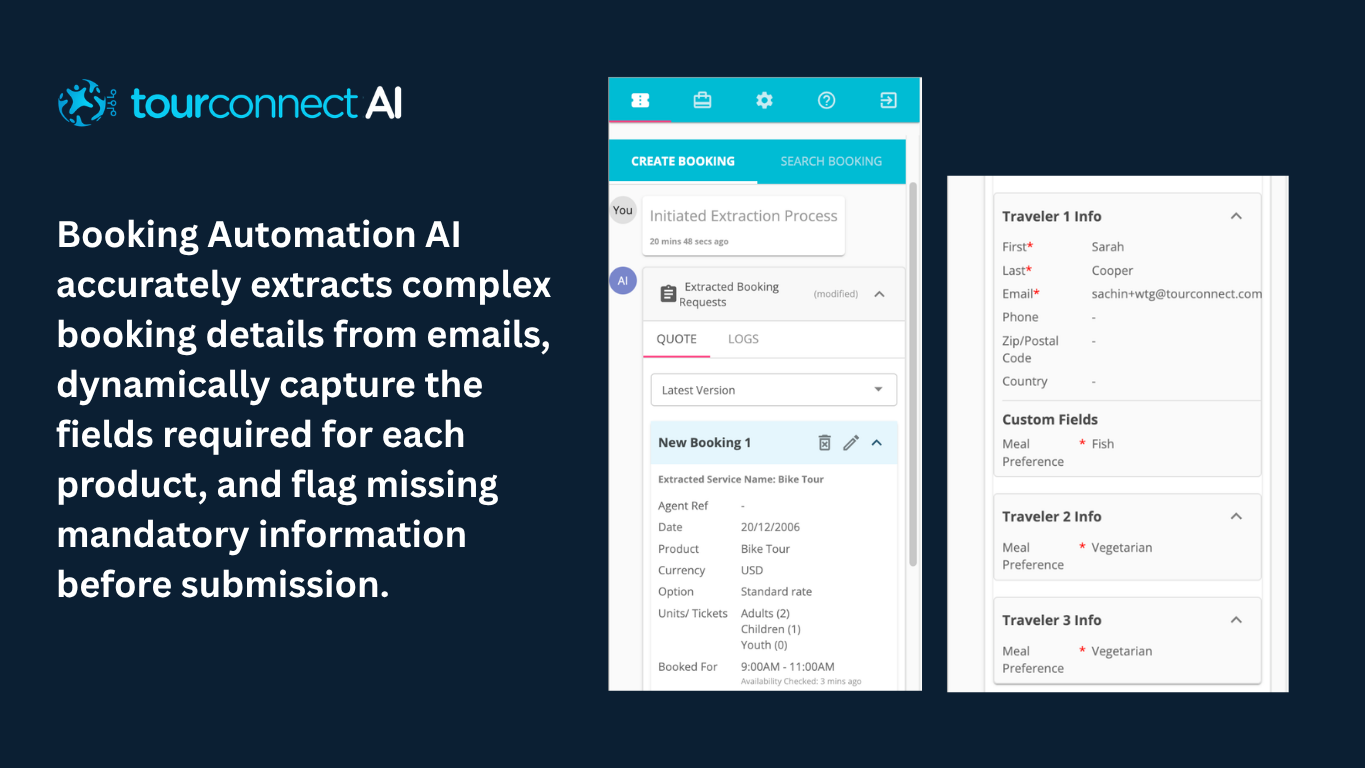
Booking Automation AI extraction process from our Outlook Add in
Booking fields that adapt to the product being booked
Different products require different information.
An airport transfer may need pickup and drop-off locations. An activity could require passenger information or additional product-specific selections. Other products may have their own mandatory fields configured in the operator's booking system.
The updated Booking Automation AI dynamically displays fields according to the configuration of the relevant product. Fields that aren't required can remain out of the way, while the information needed for that particular reservation is surfaced to the user.
This makes the automation more closely reflect the way the underlying booking system is configured rather than forcing every reservation through a generic set of fields.
For tour operators with broad product portfolios, that distinction becomes increasingly important. Automation needs to adapt to the booking rather than asking the reservations team to adapt the booking to the automation.
Mandatory field validation before the booking progresses
Extracting booking information is only part of the process. The system also needs to know whether the information required to complete the booking is actually present.
Booking Automation AI now surfaces mandatory fields based on the booking system's field configuration and uses inline validation to identify required information that is missing. The user can resolve those gaps before submission rather than discovering them later in the booking process.
This provides an additional layer of control around automated bookings. The objective isn't simply to enter data faster, but to help ensure the booking contains the information the operator's own system and products require.
Single and multi-bookings now work in one workflow
One of the largest changes in this release is Multi-Bookings 2.0.
Previously, single and multiple bookings were handled through separate parts of the interface. The new experience brings them together into one centralised workflow. Booking Automation AI determines what has been extracted and dynamically presents either a single booking or multiple bookings within the same workspace.
For an individual booking, the user receives a streamlined entry to verify. When an enquiry contains multiple bookings, the workspace expands to display them together for more efficient review and processing.
This extends the usefulness of Booking Automation AI beyond straightforward individual reservations to workflows involving groups, group series and other multi-booking scenarios.
For operators processing bookings at volume, that is particularly significant. A single incoming communication can represent substantially more work than a single reservation, and the automation now has a better way to represent and process that complexity.

Booking Automation AI can process a series of bookings across several days from your Inbox.
A faster way to review AI-created bookings
Automation still needs to give reservations teams appropriate visibility and control.
As the amount of booking information Booking Automation AI can extract has grown, displaying every field as an active input box made the interface increasingly difficult to scan. The redesigned experience instead presents extracted information in a clean, read-only summary.
The reservations user can quickly review what the AI has extracted and, when something needs changing, enter a dedicated editing workflow with a single action. Additional product fields are also organised into a dedicated section so that extracted information remains visible without overwhelming the main booking view.
It is a relatively simple interface change, but an important one for everyday use: AI does the extraction and structuring; the reservations team can review, correct where necessary and continue the booking.
Booking automation without changing where your team works
Booking Automation AI is designed around an important principle: automation shouldn't require reservations teams to abandon the workflows and systems they already know.
The TourConnect AI add-in sits within the user's inbox. From there, Booking Automation AI can interpret an incoming booking request, work with the connected booking system and prepare the structured booking for the user to review and confirm.
That means the reservations agent can remain in the email workflow where the booking request originated while AI handles much of the checking, extraction and booking-system work behind it.
The latest release makes that model more capable. Better extraction handles more of the information contained in the original request; dynamic fields adapt the workflow to the product; validation identifies missing requirements; and multi-booking support allows more complex requests to be processed within the same experience.
Built for the booking systems tour operators already use
Booking Automation AI is available for tour operators using FareHarbor, Ventrata, Zaui, Rezdy, Bókun, Peek Pro and RMS, allowing operators to introduce AI automation around their existing reservation infrastructure rather than replacing their booking system.
This is an important distinction when evaluating booking automation. The booking system remains the operational system of record. Booking Automation AI addresses the repetitive work that happens between receiving a booking request and getting the correct information into that system.
For an established operator, that can provide a much more practical path to adopting AI: start with a high-volume workflow your team already performs every day and automate the repetitive steps around it.
See what Booking Automation AI can automate in your operation
The range of reservation scenarios that can be automated continues to expand. With this release, Booking Automation AI can interpret more complex booking information, adapt to product-specific configurations, identify missing mandatory data and handle both single and multiple bookings through a unified workflow.
For existing users, the update means more booking scenarios can move through a cleaner and more capable automation experience.
For tour operators using FareHarbor, Ventrata, Zaui, Rezdy, Bókun, Peek Pro or RMS, you can start with your own booking requests and see how Booking Automation AI works with your existing system and products.
Start a free trial of Booking Automation AI and put your own booking emails through the workflow.